Riddle Me Wisdom – King Solomon to King Hiram & Vice Versa – Shared Language & Lateral Stimulation

SOLOMON: HIS LIFE AND TIMES.
BY REV. F. W. FARRAR, D.D., F.R,S.
ARCHDEACON AND CANON OF WESTMINSTER; AND CHAPLAIN
IN ORDINARY TO THE QUEEN. 1886?

Various forms of veiled and pregnant speech known as “riddles” and “dark sayings” were also much cultivated in this epoch of literature. Riddles have always played an important part in the story of the East. Josephus preserves a curious tradition that Solomon, and Hiram, king of Tyre, challenged each other to trials of skill in this form of “wisdom”—inability to read the riddle being acknowledged by pecuniary fines.5 At first Hiram was entirely defeated in this intellectual contest, but at last he discovered a Tyrian youth named Abdemon, of great natural gifts, by whose assistance he successfully encountered, and even defeated, his royal ally.
5 Comp. Theophilus in Eusebius, ” Præp. Ev.” ix. 34, § 19.

Leave a Comment

Modern humans migrated out of Africa via a southern route through Arabia, rather than a northern route by way of Egypt – The Genographic Project – National Geographic Society

Modern humans migrated out of Africa via a southern route through Arabia, rather than a northern route by way of Egypt, according to research announced at a conference at the National Geographic Society this week.

http://newswatch.nationalgeographic.com/2011/11/03/modern-humans-wandered-out-of-africa-via-arabia/

In itself, somewhat remote and not earth shaking. But, down the road this research will lead to further research which may lead to a clearer picture of the place of origin of E1b1b1c1a M84 and therefore us. It will more easily explain our admixture of Asian, near Eastern, North African genes along with our Northern European genes.

Leave a Comment

3rd to 4th cousin – Eugene Yurtsev – Closest possible unknown relative identified to date.

Eugene Yurtsev is the closest possible unknown relative identified to date. Eugene and I have made contact on 23andMe.

Third cousin means that we might share great-great-grandparents, in other words, Frank’s grandparents.

He will be exploring his family tree with his family in the coming days. What I have learned is that a few years ago he migrated to the United States from Israel where he and his family had migrated from Belarus (600 km x 600 km; landlocked; surrounded by Ukraine, Poland, Russia, Latvia and Lithuania).

The lab matching determined that we share 0.41% of our genes and 4 chromosome segments: two on chr 1, and one each on 6 and 12.

However, we don’t share common Y haplotype or Mitochondrial haplotype. Since his Y chromosome is not our E, then his intervening line of descent, at some stage was through the maternal line.

My brother Brian shares two on chr 1 and 1 on chr 6. Curiously, my son David shares the most segments, 5, whereas son Jon shares none at all.

David shares: chr 1 x2; chr 6 x 2; chr 12 x 1.

Stay tuned.

Leave a Comment

Immigration to America in the 1800s

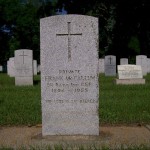
For the time being, we are assuming that Francis “Frank” Freeman McCallum was born to immigrant parents, perhaps on board ship during the voyage to America. In his WWI Canadian military attestation documents he claimed to be born on October 27, 1891. The actual range may be a year on either side, approximately 1890-92.

His parents’ nationality of origin remains a mystery.

The best statistics that I have found of the country of origin of immigrants is an American Senate report from 2011. It provides a year by year breakdown by country for that period. It can be found at http://www.latinamericanstudies.org/immigration/immigration_1820-1903.pdf

Leave a Comment

23andMe Ancestry Lab Test for DNA Shared with Ashkenazim

It looks as if we have a high level of DNA shared with Ashkenazi meaning that gramps was highly probably Jewish. This is the strongest confirmation yet of the guess that Jim made. I have asked a 23andMe expert for confirmation of my interpretation.

It is worth bearing in mind that the Most Recent Common Ancestor, the progenitor of our E haplogroup was born between 2175 BC and 875 BC. By comparison, while Shem, son of Noah was the progenitor of the Semitic peoples, Abraham, the common ancestor of Jews, Muslims and Christians lived about 2000 BC, give or take a significant handful of years. The Phoenicians lived as an identifiable group from about 3200 BC to 312 BC. I think that while E haplotype E1b1b1c makes up about 10% of modern Ashkenazi and Sephardic Jews, it is conceivable that our line came up through one of the non-Hebrew Phoenician trading posts around the Mediterranean. It is conceivable, but probably a low percentage option given the nature of migration to North America in the 1800s.

My test results are below, using the 23andMe Ancestry Lab test utility, turning on the the Ashkenazi test and indicating 1 grandparent, gramps, from the same country (whatever that is, even if it is the US).

If set Minimum Segment Length in cM @

5
7.5
10
15

% Declared Ashkenazim at each of the 4 lengths

27.3%-49.8%
16.1%-29.9% Brian 20.2%-36.9%
8%-13.6%
1.7%-3.7%

Not Declared
29.8%-52.4%
14.6%-28.4% Brian 18.5%-36.2%
6.1%-11.8%
0.8%-2.8%

Brian did the same test and produced the following results at 7.5 cM. As shown above, his results were 20.2%-36.9% declared, 18.5%-36.2% undeclared. All of these results are significantly higher than my results.

Note: also read the GEDmatch Admixture posting under Category DNA or Research. It is a geographical breakdown of the DNA.

Ian

Leave a Comment

Certain Relatives

More certain relatives (single strand more than 10 Centimorgans long) from 23andMe. Some are duplicates from previous list.

If any of them (you) come to this site please establish contact by emailing me at ian@marrette.cc

SegmentLengthInCentiMorgans
Larry Baum 26.2
JOSH JABLON 24.4
Martin Varsavsky 18.5
Michael Schonbaum 17.1
Anthony Bates 16.6
DG Party 12 15.8
Jeffery Stein 14.6
Gary Nachman 14.5
Lee – 13.9
Andrea Gargiulo 12.9
JOSH GITLIN 12.8
Naomi Torpey 12.7
STEVEN KRICH 12.7
Annette Murch 12.6
Laura Tesler 12.4
Robert Lefkowitz 12.4
Daniel Williamson 12.1
Helene Carman 12
Valerie Podlesnaya 11.9
Anonymous0222 11.8
Chris Jones 11.8
Elizabeth Bakwin 11.8
LAWRENCE TESLER 11.7
Alexandr Ivashchenko 11.4
Andy Warner 11.1
Brian Hawthorne 11.1
Stuart Opotowsky 11.1
Cara Weisman 11
Meredith Sellers 11
Cheryl Schweitzer 11
Charles Bockoff 10.9
David Elkins 10.9
Doug Evans 10.9
Fedor Karpelevitch 10.9
orderedchaos 10.9
Yuliya Ivashchenko 10.9
Carl MGB 10.8
David Friedman 10.6
deaconSandy 10.6
California Sam 10.6
Donovan1 10.6
ken levine 10.6
Edward Kazyanskaya 10.4
Ilya Shlyakhter 10.4
Sandy Yancey 10.4
Sari Friedman 10.4
Amanda Garnica 10.2
Richard Hawk 10.2
Russell Conser 10.2
SpeaksCohn 10.2
Jan Greenspan 10.1
Mizya Blyakher 10.1
Richard Cahn 10.1
Brent Gendleman 10
Dane Elliott 10
David Toube 10

Leave a Comment

Relatives – 19 Names From GEDmatch

Apparently, when two individuals have shared matches of a single DNA strand greater than 10 Centimorgans in length, they are definitely related, probably in the 3rd-5th cousin range.

If any of them come to this site, I would appreciate them (you) sending me an email at ian@marrette.cc .

GEDmatch has found a few for us. FYI, their GEDmatch names are:

Anthony Bates (16.6 cM)
Lee 13.9 cM

Fedor Karpelevitch
ken levine
Alexandr Ivashchenko
Orderedchaos
Yuliya Ivashchenko
Mizya Blyakher
Richard Hawk

Jan Greenspan
CarlMGB
*MSellers
Dane Elliott

Elizabeth Bakwin
Ilya Shlyakhter
Donovan1
Robert Lefkowitz
Naomi Torpey
SpeaksCohn

There are a whole whack more between 5 and 10 cMs, that are considered possible relatives.

Leave a Comment

Geographical Connections Through GEDmatch Admixture Analysis

Updated September 18, 2011

Today GEDmatch added a new utility for analysing individuals complete DNA file and coming up with an admixture breakdown by geographical region. I had the utility analyse my data and it produced the columns below.

I wondered what it might say about Frank so I decided to subtract my known western European DNA (mother=50%; paternal grandmother=25%) from the western European total and distribute the difference proportionally across the rest of the percentages. I also decided to try it with taking out 100% of western European DNA to simulate 100% of it coming from the two women. However, it is worth noting the discrepancy between the 75% of DNA contributed by those 3 grandparents is far larger than the 44.9% Western Europe DNA turned up in the analysis. Since we don’t have either DNA analysis or genealogical information on them to use to make a decision about further data extractions, I just left that 30% in.

This discrepancy raises a question however. Theoretically, the total western European DNA credited to Molly and Dory should total almost exactly 75%. However, the analysis only shows 44.9%. What happened to that other 30%? The only explanation that I can think of is that either Molly or Dory or both had some DNA from non-Western European sources. That would be news to me. However, Brian suddenly remembered a conversation with Dory in which she mentioned that her father had mentioned the possibility of some Moroccan ancestry! We have not had time to talk abut that further. In the meantime I am trying to contact Dory’s cousin Tony in Oakville to see if he knows anything or knows if any family members have had DNA testing done. Also, I’m going to contact Bryce, Jeannine and Dennis Sharpe to see if they can shed any light on an Italian connection to the family that his mother, Molly’s half-sister may have mentioned. There was something about a ship building, which was her father’s business.

The distribution over the regions is interesting on its own. However, the adjustment to the western Europe DNA produces fascinating results. After extracting Western Europe, in a gross consolidation the Mediterranean and the West Asian (Arabian Peninsula) added together to total 55%. If you also add SouthWest Asia that total climbs to 62%. Eastern Europe is 30%. The residual 8% is Asian or African.

West Asia includes Saudi Arabia, Israel, Jordan, Lebanon, Syria, Iraq, part of Iran and Turkey as well as smaller countries.

If you want a visual definition of West Asia and the other Asian sectors see the colour map at http://en.wikipedia.org/wiki/Geography_of_Asia

For the time being, we don’t have an explanation for the Eastern European contribution, but it % size would suggest that it is a relatively recent contribution. The original 29.6% would suggest that either of Frank’s parents could have made that contribution but it is unlikely that that great-grandparent would have 100% Eastern European DNA.

GEDmatch Admixture Analysis of Ian McCallum
9/3/2011
**Adjustment by Subtracting Obvious Western European DNA
Mother DNA % 50%
Grandmother DNA % 25%

Removing 100% of Western Europe
New Weighting
Population Self Added
East_European 29.6%
West_European (removed 44.9%)
Mediterranean 44%
Neo_African 0.2%
West_Asian 11.3%
South_Asian 2.3%
Northeast_Asian 1.0%
Southeast_Asian 0.7%
East_African 0.5%
Southwest_Asian 6.7%
Northwest_African 3.5%
Palaeo_African 0.4%
100%

Adjusted Summaries
East_European 30%
Mediterranean+West Asian (Arabian Penninsula – Lebanon, Israel, Jordan, Syria, Iraq, Saudi, Yemen etc) 55%

Note: also read the 23andMe Ancestry Lab posting under Category DNA or Semitics. It is a breakdown of the DNA that is shared with Ashkenazim.

Ian

Comments (1)

Phoenician Secrets – by Sanford Holst

Published in early 2011, this book is a great read that pulls together a great deal of information about the Phoenicians and their 3,000 year history from 3000 BCE.

Why is that relevant to our search? Along the evolution of our E haplotype, during the string of mutations, about 1250 BCE one originated in the north eastern Mediterranean. Until 2008 it was referred to as E3b.

According to the 2008 study Identifying Genetic Traces of Historical Expansions: Phoenician Footprints in the Mediterranean, E3B is one of the strong Y-chromosome markers in the Phoenician colonization of the Mediterranean.

So what? Well the book tells us why we should be interested and there is a lot to tell. For one thing, the Phoenicians created written language in order to standardize record keeping as they dealt with multiple cultures that used a variety of slowly applied cuneiform or hieroglyphic techniques more suited for temple adornment or immortalizing deities, warriors and rulers than they were for recording a grain or precious fabric transaction.

So what about the Hebrew connection? Well the Phoenician King of Tyre, Hiram, became best friends with the threatening Hebrew invader, King David and then with his son King Solomon. King Hiram and his successors provided David and Solomon with all the Cedar from Lebanon and the wood and stone working craftsmen in order to build Solomon’s temple and his palace in Jerusalem . The principal Phoenician craftsman, another Hiram, had a Jewish mother. One of King Hiram’s daughters became one of King Solomon’s many wives.

As you know, the E3b haplotype is carried by 10% of Sephardi and Ashkenazim Jews.

The book does not get into the shared DNA or go very deep into the Phoenician/Hebrew relationship, which is so detailed in the Old Testament. However, it does suggest the many multi-level influences that the Phoenicians had on the peoples with which they traded and where they had trading posts and small colonies, the Egyptians (founding Alexandria), the people who became the Greeks, the Anatolians, the peoples who became the Italians, the Spanish, the Maltese, and the North Africans, founding Carthage.

The book draws on many sources including the Greek historians as well as the Old Testament and other documents, and archaeological digs.

One of the most interesting aspects of their existence was that over their 3000 year old existence they were able to survive without an army, with two brief exceptions. Instead, they relied on a combination of techniques. First, they made themselves indispensable to their neighbors or the putative invaders by striking profitable trading relationships with them. Second, they blended in by adopting some of the social customs of the invaders or their trading post neighbours and did not present themselves ostentatiously in the way that they lived or practiced their religion.

They ensured secrecy and loyalty to the group by guaranteeing that that everyone had a strong vested interest in the success and well being of the community.They ensured that everyone had a stake in the profits or losses from trade. They ensured that there was not an extensive wealth gap between the most wealthy and the least wealthy. This treatment they also extended to neighbours such as the Minoans when they wanted to establish a trading post.

If one community had to be evacuated, the people were immediately absorbed into the other trading posts. When the time became right to return to the vacated trading post, if it had been destroyed by invaders they would rapidly rebuild it in as little as six years, with all other communities contributing money, materials and labour. This speed of reconstruction was unheard of elsewhere in the ancient world where zero sum games were the rule of the day.

They were highly secretive. There are very few records of Phoenician society by Phoenicians. One of the reasons is that when they evacuated a trading post they took with them their critical records and burned the rest.

Finally, they evolved a tactical superiority that suited them. Apparently evolving from a fishing culture, they established dominant deep water ship designing and building. They used that to dominate sea trading. To render themselves less vulnerable they avoided attachment to land territories, preferring to use islands for their trading posts.

This provided them with many advantages. They chose islands that provided two natural harbours which they augmented with stoneworks. The built the twin harbours so that they would always have a safe harbour to enter and where to load or unload cargoe, regardless of the weather and tide conditions. Islands could not be easily attacked by land based armies which were the threats of the day. Islands could be rapidly evacuated in the face of a serious threat.

These factors removed their need for a standing army, and removing the need for a standing army they eliminated a major cost to the community thereby providing them instead with funds and labour with which to develop shipping and trade.

They were a totally democratic society, with elected not inherited leadership. They were a people organized totally around trading and the their far flung trading posts co-ordinated trade, establishing specializations and transshipping in order to hide sellers from buyers, reduce their risks by using smaller vessels for local trade and thereby avoid becoming too tempting for pirates.

The U3b haplotype seems to have originated in the vicinity of Haran, the home of Abraham, which today is in southern Turkey 10 km from Syria. The Phoenicians predominantly operated some 250 to 300 kms south west on the coast in the cities of Byblos, adding Sidon, Tyre and then what is now Beirut. These are all now in Lebanon.

Unlike their polytheistic neighbours with mostly male deities, they practiced monotheism with a feminine deity who later had a male consort.

Needless to say, I highly recommend reading this book, even just for sheer entertainment and growing appreciation of an innovative and wise civilization which we may be able to lcaim as part of our heritage.

Phoenician Secrets – by Sanford Holst, Santorini books, ISBN 978-0-9833279-0-5 $18.95

http://www.phoenician.org/Phoenician_secrets_introduction.pdf

Leave a Comment

Family Photos

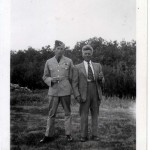
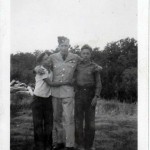
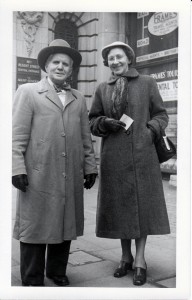
Frank & Molly McCallum London early 1950s

Leave a Comment